








Introduction
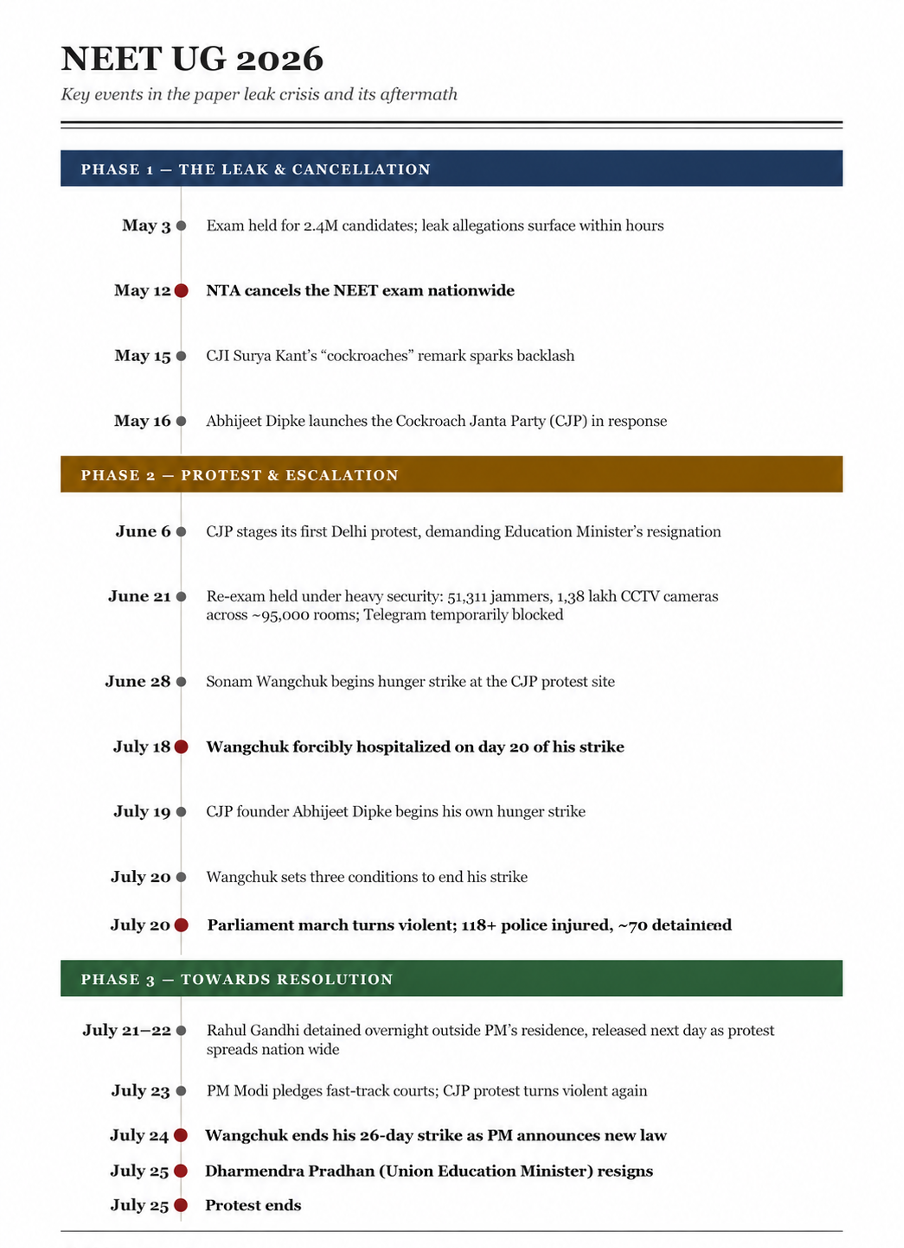
India’s Union Minister of Education Dharmendra Pradhan submits his resignation to PM Modi after a 50-day-long protest led by the Cockroach Janata Party (CJP). Pradhan’s resignation came when the protest in India seemed to be at a critical point, with the future remaining uncertain. The protest emerged as a significant challenge to the government as students took over the streets demanding accountability regarding the National Eligibility cum Entrance Test (NEET) paper leak scandal. The series of events that followed the protest showed the impact of social media, youth engagement, and the uprising of Gen Z protests in India. The resignation of Education Minister Pradhan isn't really the end of the story. It's the point where a new question opens up: what does CJP do with the win it just got? In under two months, CJP turned itself into a real force in Indian politics not only because it managed to push a sitting union minister out of his job but also the protest against the government started spreading nationwide with youth coming to the streets. The real question now is whether CJP can actually be more than that one win, or it was only the starting of new changes in Indian politics. This article highlights the timeline of the protest from the examination date to the resignation of the India’s Union Minister of Education Dharmendra Pradhan, and also tries to compare the Gen Z movement in Nepal and India.
How the Cockroach Janta Party (CJP) Formed
The formation of CJP started small, with a single comment from the Chief Justice of India Surya Kant. On May 15, the Chief Justice of India compared unemployed youths to “parasites” and “cockroaches” during a Supreme Court hearing.[1] Though, he clarified later that it was intended for people, who carry a fraudulent degree. After the incident, Abhijeet Dipke, a recent US graduate, jokingly put out a call on social media about the CJI's remarks on unemployed youth, stating, “What if all cockroaches came together?” [2] The immense response compelled Dipke to build a website and social media accounts for the Cockroach Janata Party (CJP), a satire of Modi’s ruling Bharatiya Janata Party (BJP). Within two weeks, CJP had more than 22 million followers on social media and was met with Modi’s government blocking CJP’s social media accounts, citing national security concerns.[3]
The Problem and its response
The Indian education system has, throughout its history, faced several challenges related to exam paper leaks and technical failures. The NEET is India's largest medical entrance exam. This year, nearly 2.3 million test-takers took the test across India.[4] The exam held on May 3, 2026 was later found to be compromised. The National Testing Agency (NTA) acknowledged serious concerns regarding the same and cancelled the exam and rescheduled it. The announcement of the re-exam led to several suicides. Various media claimed the number has reached up to 21.[5]
The youth channelled years of neglect towards their future, and anger and frustration over the lack of accountability by the concerned government authority into one of the largest youth protests in India. Their apathetic attitude of the government has led the Cockroach Janta Party (CJP) to start a protest at Jantar Mantar, Delhi's usual protest ground, On 6 June 2026.[6] It didn't stay just a CJP protest for long; student groups joined in, and the crowd kept growing. The core demand hasn't moved: Education Minister Dharmendra Pradhan has to resign over the 2026 NEET paper leak. On 28 June, Ladakhi activist Sonam Wangchuk joined the protest and began his hunger strike, giving the protest a face and legitimacy. Sonam was dragged by the police on the 20th day of his hunger strike to the hospital against his will.[7]
People who expected that the government would at least hold a discussion with the protesters were disturbed when they witnessed the government, instead of taking accountability, use force to shatter the protest. This led to more outrage, a larger crowd joining the protest, and protesters refusing to back down.
The July 20, Monday march was intended as a peaceful "Sansad Chalo" attempt by thousands of protesters to walk toward Parliament. People travelled from across India to join the march. What was meant to be a peaceful show of solidarity soon turned violent as police responded with tear gas, water cannons, and resorted to lathi charges to break up the crowd. Both sides, the protesters as well as the police, claim casualties.[8]
Public frustration deepened when lawyers approached the Supreme Court over allegations of police violence against student protesters. Rather than addressing the issue, the Chief Justice Surya Kant reportedly remarked that the court had many other matters to attend to and emphasised that “the Supreme Court has no time for videos”.[9]
The protest became a much larger movement as it wasn't just happening in Jantar Mantar; it became a nationwide. People from all over India have joined the movement and was no longer confined to students. Opposition party members were detained soon after demonstrating outside the prime minister's residence.[10] People were expressing their concern regarding the failure of the government to protect the citizens of the nation during a time of widespread concern raised by them.
PM Modi gave his first statement on the paper leak scandal amid protest rage. Modi stated the paper leak scandal was ‘a grave sin’ and emphasised that 13 accused have been arrested and urged strict action to prevent future leaks[11]. He also assured that the culprits would face swift and stringent punishment. "Nothing is more important than the welfare and future of our youth!" Modi posted on X.[12]
Despite the attempts by Prime Minister Modi to cool down the protestors, the movement not only continued but also spread across Indian major cities creating a pressure for Education Minister Pradhan to resign.
Pradhan resigned on 25 July, 2026. The youth-led CJP called off its five-week protest following the resignation of Pradhan and acceptance of their core demands regarding exam reforms. The CJP leadership urged demonstrators to return home peacefully now that their demands had been met. By the next morning, the stage at Jantar Mantar was already being taken down.[13]
Gen-Z worldwide
Gen-Z was considered a generation that was chronically online, too distracted and too engaged with trends. The assumption has fallen apart when the youth-led protests have brought down governments in Nepal, Bangladesh and Madagascar. They also forced governments to reverse unpopular policies in Kenya, Indonesia and the Philippines and filled the streets of Rabat, Lima, Istanbul and Mexico City.[14]
When we look at Gen Z protests around the world, the demands are typically narrow, related to corruption, education, and their freedom as citizens, which culminates in exposing a much larger structural problem. People demand what they deserve and what has been promised to them by the constitution. When the needs aren’t met in a timely manner, they raise questions to the government responsible. The protests are organised around a fairly simple, shared observation: the people running these systems aren't following the same rules that the constitution demands to be followed invariably.
Young people have always been at the forefront of these protests. A study found that youth made up a substantial share of the frontline participants in roughly 80 per cent of the nonviolent campaigns that removed governments between 1990 and 2020.[15] What is different this time is not that the youth are on the streets. Instead, it is the nature of construction and mobilisation of the protesters, along with the pace of the movements.
These protests do not have a central leader or a conventional party structure behind them. They're organised the way most of Gen Z organise in other domains – decentralised and coordinated through whatever social media platform that hasn't been banned yet in their respective countries. In Nepal, the Gen Z protest was highly communicated through Discord, which became a major discussion platform. It served as a space where information about protest routes, meeting points, and updates spread rapidly, helping people mobilise in real time. In India, a satirical Instagram account overtook the ruling party's own follower count within a week. A single protest symbol, a pirate flag from the manga One Piece, has appeared at protests in Madagascar, Morocco, Peru, Indonesia and Mexico, recognised instantly by people who don't share a language or borders.[16]
That constitutes the actual shift. It is not that this generation bears more rage than the rest. It's that we're more connected to each other's uprisings in real time. This means a government can no longer treat a protest as a local problem. Earlier, the government could wait till the protest died down and be unresponsive to the growing unrest. Now, quicker information flow on the internet leads to stronger demands being made. The silence of the government shows their unwillingness to take accountability. It also reflects how they are not well-equipped to handle this flow of information in this newer political dynamic.
Delhi and Kathmandu
When we look at the two movements side by side, while the demands of the protest were met in both cases, the real difference is what happened on the ground and how the youth channelled their anger. Nepal's protest lasted two days, 8 and 9 September, and by the end of it, Singha Durbar, the Prime Minister's Office, the Supreme Court, Parliament House, multiple ministry buildings and several private buildings and business institutions were on fire.[17] An assessment, cited in an issue brief of the Asian Institute of Diplomacy and International Affairs (AIDIA), estimated direct economic losses closer to Rs 125.26 billion once retail, hospitality, banking, manufacturing and small businesses were factored in. SMEs alone account for an estimated Rs 60 billion of that. Seventy-seven people died, 59 of them protesters, several police officers, and a number of prison inmates were killed trying to escape during the chaos. The army was called in, and a curfew was imposed the day after Parliament burnt.[18]
When we look at Delhi, it never got there. Nearly seven weeks of protest, tear gas, lathi charges, heavy surveillance and targeting by the police with injuries on both sides, but no deaths was recorded. There was some violence, especially the crackdown on 20 July, but it stayed as a policing problem rather than a security issue. Unlike Nepal, the restraint shown by both the protesters and police was remarkable in New Delhi and other cities of India.
Nepal’s protest later moved beyond a single grievance and brought into the limelight the unfair treatment of the government towards its people, not just the ruling one, but all the ones that have been in power in last three decades. Nepali youth coordinated loosely across Discord servers that had over 100,000 members without any discrimination or exclusion towards who became a part of it[19] and conveyed their anger against corruption and economic stagnation in the country. It was closer to a general mass uprising than a single-issue protest. In contrast, Delhi protest's core base was rather contained: the CJP itself, along with established student unions like SFI, AISA and AISF. It was organised around one main demand – Education Minister Pradhan's resignation over the NEET leak, which later followed by the financial compensation for families of students who died by suicide and revocation of legal cases filed against student protesters. It is a movement that stayed rooted in the issue that started it, rather than becoming a platform for voicing the adjoining frustrations against the governance and government.
The response of security towards the protestors was also difference between Nepal and India. Nepal's police opened fire on protesters on the very first day itself, and by the time the army and curfew arrived, the situation was so worse that the streets witnessed complete statelessness. Delhi Police used tear gas and batons, which were injurious to both sides, but never used live ammunition and never reached to a point where the government needed the military to restore law and order.
Nepal’s Gen Z movement which started as a peaceful protest turned violent in the first day itself in an unimaginable way that the security agencies and the then government failed to foresee, prevent, or effectively respond to. However, India’s movement was manageable, and the government and securities agencies were successful in containing.
And yet another start difference is the ending of the movement. Nepal's protest forced the sitting Prime Minister KP Sharma Oli to resign within 48 hours, most probably the record time of government topple in modern world history. It was fast, but it came at a cost of dozens of lives and a reconstruction bill the country is still trying to pay off months later. Delhi's protest took quite the opposite shape; it was slower, and it never touched Modi's government directly. What it got, in the end, was also specific: Education Minister Pradhan's resignation, while the compensation for the families of NEET aspirants who died by suicide, and the withdrawal of cases against protesters are still pending. The CJP's demands were met without a single death and without changing, who runs the country. What connects the two is not really the outcome. It is the same underlying demand that the people running these systems answer for their failures instead of waiting them out.
The Demand for Accountability
Most of these protests aren't demanding a different system of government. Looking at the actual demands, country by country, they are fairly modest. They ask the government not to take money (bribe) for public services, not to leak the exam papers, and to be transparent and accountable, when something goes wrong, instead of waiting for the protest to be over. The same pattern keeps showing up across the borders: No jobs, an education system people don't trust, and governments that seem to just wait for the anger to subside instead of dealing with it. Delhi isn't really new. It's just the latest version of something South Asia's young people keep going through.
[2]https://www.theguardian.com/world/2026/jun/08/cockroach-janta-party-youth-movement-india-politics
[3]https://www.theguardian.com/world/2026/jul/20/who-are-indias-cockroach-janta-party-and-why-are-they-staging-protests-
[5]https://www.reuters.com/world/asia-pacific/the-fear-killed-her-how-an-exam-scandal-india-sparked-student-uprising-2026-07-25/
[6]https://www.channelnewsasia.com/asia/india-cockroach-janta-party-abhijeet-dipke-protest-6166131?utm_source
[8]htps://frontline.thehindu.com/the-nation/cjp-protest-sonam-wangchuk-crackdown/article71266486.ece
[9] https://timesofindia.indiatimes.com/india/dont-have-time-to-watch-videos-supreme-court-declines-plea-for-suo-motu-action-on-jantar-mantar-protest/articleshow/132552102.cms
[10]https://www.aljazeera.com/news/2026/7/21/police-arrest-indian-opposition-leader-gandhi-as-protests-continue-to-grow
[11]https://www.indiatoday.in/india/story/pm-modi-neet-paper-leak-a-grave-sin-at-nda-parliamentary-meet-vows-strict-punishment-for-accused-2952539-2026-07-21
[12]https://organiser.org/2026/07/23/371330/bharat/neet-paper-leak-row-pm-modi-announces-fast-track-courts-nothing-is-more-important-than-our-youths-future/